
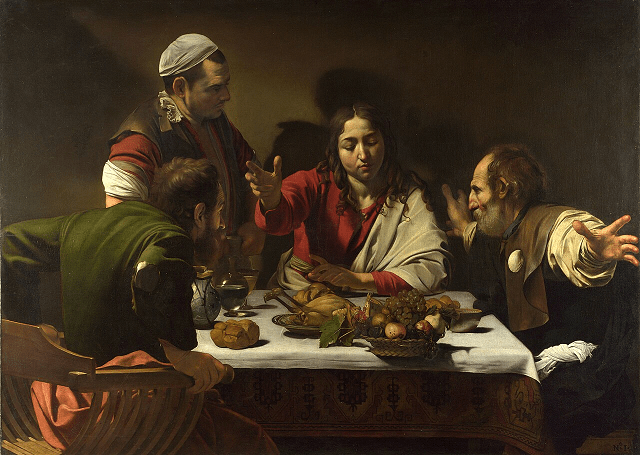
The Supper at Emmaus by Caravaggio – National Gallery, London
Foolish disciples
After Easter this year I was pulled up short by reading the passage in the Gospel of Luke chapter 24, which we fondly call ‘The Two on the Road to Emmaus’, despite the fact that there were obviously three of them. What caught me was Jesus abruptly intervening in the conversation by saying, ‘How foolish you are’. That got their attention. We don’t hear another word from their side of the conversation until they insisted that he break his journey and join them for a meal.
So, what was so foolish about them? You might think it was their dismissing the reports of Jesus’ resurrection – they had even set aside the report by the angels themselves who said he was alive. But that’s not where Jesus started. He pointed out how slow they had been to believe all that the prophets had spoken. It was like, ‘Guys, did you miss the emails?’
He pointed out that, ‘beginning with Moses’ (they knew this was going to be a long talk) there was one unavoidable fact. The promised Messiah wouldn’t be leading anybody to a glorious future before going through immense suffering first. The reason that nobody was going to glory yet was because there was one big, massive obstacle that only massive suffering, by no less than a Messiah, could deal with. Sin.
The story of ugly
It’s such an ugly word but that was precisely his point. Only such an ugly death would blast through such an ugly obstacle. So, he quoted Moses (who filled over 30 chapters of our Bible with the requirements of sacrifice before sin can be dealt with). He quoted the prophets. We can imagine he didn’t skip Isaiah chapter 53 since he had just experienced the painful meaning of those words on Friday.
By the time they got to Emmaus, Cleopas and his friend may have remembered that the apostle Peter had argued this exact point with Jesus back some months ago (Matthew 16:22-23). Peter just couldn’t swallow the idea that Jesus would ‘have to be killed’. Peter hadn’t come out of that argument well. In fact, none of the disciples ‘got it’. In his Gospel, John tells us that Jesus patiently spent three years with them while they were still psychologically stuck at thinking that Jesus would surge on to triumph without any major difficulty. John tells us that it was only ‘after Jesus was raised from the dead that his disciples recalled what he had said’ … about his coming death.
The three arrived in Emmaus. Thanks to Caravaggio’s painting ‘The Supper at Emmaus’ we have an idea of what might have happened next. But it was still going to be a long day. Jesus showed them who he was and then disappeared. Then they disappeared, at speed, back to down the 11 kilometres to Jerusalem to meet up with the rest of the disciples so everybody could report to everybody else. But that was far from the end of the day.
The next thing Bam! Jesus appeared in the middle of their excited group and proved he was the real thing. They watched him eat grilled fish (above all things). Then the day’s big lesson began. More Old Testament. This time Jesus specifically included the Psalms. They will have heard him roar one of them (Psalm 22) in agony during Friday’s crucifixion.
Launching a global movement
Now he expanded on the Emmaus story. The order of events predicted in the Old Testament was (a) the Messiah’s suffering (b) the old sin issue would be dealt with and now, (c) these newly awake disciples would be the ones to bring this news about sin not only to the rest of their Jewish people but to every other ethnic group on earth. The Messiah wasn’t going to be just for Jews after all.
Just imagine! A Messiah for Gentiles! They were supposed to have worked that out from Moses, the prophets and the Psalms. Now that Jesus had given them enough introduction, they would happily spend the rest of their lives discovering, enjoying and passing on the details. As Dr. Chris Wright (the biblical scholar who represents the Langham Partnership International) has said, ‘I am so glad that the day my Lord rose from the dead he gave a course in Old Testament survey. Twice’.
Startled prophets
That very same apostle Peter appears to have taken this seriously. In his first, short letter he proves his points by quoting the prophet Isaiah four times. He also gets fascinated by what was going on in Isaiah’s head – and all the other prophets’ heads.
He gives us a glimpse of what your average prophet was curious about (1 Peter 1:10-12). Apparently, they foresaw the phenomenon of Christ’s sufferings ‘and the glories that would follow’ but their big questions were: when exactly would this happen? and under what circumstances? They weren’t the only ones interested in this subject. Peter tells us that the angels longed to look into these things. The prophets ‘longed’ too – so much that they ‘searched intently and with the greatest care’.
In what must have been an eye-popping moment for Isaiah and company, Christ, by his Spirit, then points them to the actual details of how their prophecies will be fulfilled. He tells them that it will be over 500 years hence. It’s like he handed them binoculars and said, ‘Look into the far far distance. Do you see that group of people there meeting together after the Messiah has landed and suffered. They’re called “the church”. They’re celebrating his resurrection. They are just beginning to experience the glory that you have been writing about’. Don’t you think those prophets had every reason to die happy?
The power of a Granny
To get an all-round picture of what the Old Testament can do for us we need to turn to that dynamic duo, Paul and Timothy. Paul wasn’t the first person from whom Timothy had learned the Old Testament. He had heard it from his mother Eunice and indeed his grandmother Lois, who must have been one of the first Christians ever. Now Paul writes to Timothy (2 Timothy 3:16-17) to say keep at it! – the Old Testament is good for you! In fact, you’ll find yourself ‘thoroughly equipped for every good work’. Who wouldn’t want that level of qualification?
It gets better. Sometimes you can be highly qualified but also decidedly discouraged. So Paul reminds the Romans that ‘everything that was written in the past was written to teach us, so that through the endurance taught in the Scriptures and the encouragement they provide we might have hope’ (Romans 15:4). God knows us through and through. He knows what we’re made of. So along with all the other food in the Old Testament he makes sure we get our vitamins.
 the electrician's children
2 responses to “Why you don’t want to be just a New Testament Christian”
Great article, David, loved it! I remember you speaking on this Emmaus story very many years ago. You said that when Jesus vanished after the breaking of the bread, where did He go? I think you said that Jesus ‘dematerialised’ – now you see Me, now you don’t, but I am with you always.
LikeLike
Thoroughly refreshing David. Your style reminded me of J.B. Phillips.
LikeLike