
Rite & Reason: I keep meeting people who tell me that, no matter how hard they look, they can’t see resurrection anywhere in the statue
David Wilson
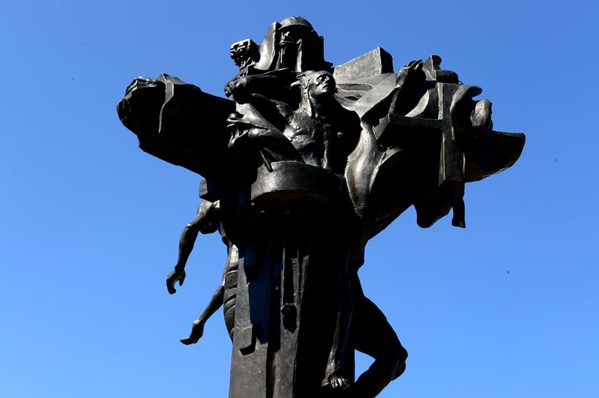
Dún Laoghaire has long been proud of nudging the national interest towards the meaning of life. It did this in the 20th century through its artists, writers and poets. And it has done so through the sculptor Andrew O’Connor. He has been all but overlooked although his work is placed in such a commanding position that it looks out over Dún Laoghaire harbour.
The first day I saw it I was sure this was another anti-war monument. It is in fact a statue of the crucifixion of Jesus, officially known as the Monument of Christ the King – but it is not outside a church. Rather, it stands high above Moran Park in the centre of town. With Dún Laoghaire being so doggedly nontraditional, the statue was placed in an open space so as to be “ecumenical.”
The hundreds of visitors who now eat their quiet Sunday lunch in Moran Park may not notice the contortion of the monument or its tortuous journey to its current position above their heads. The brave souls who climb the steps to scrutinise it can’t miss its enormity – it is 5.5m high and weighs 3½ tonnes. But they often come away baffled because the official plaque on the monument’s plinth tells us (in French, German, Spanish, English and Irish) that what we are seeing symbolises “three distinct aspects of Christ’s life”: “Desolation, the crucifixion under a darkening cloud; Consolation, Christ resurrected, restored, even youthful, with arms outstretched to console all mankind and; Triumph, Christ the King in majesty emerging from the tomb.”
I keep meeting people who tell me that, no matter how hard they look, they can’t see resurrection anywhere in the statue. So, what was the sculptor thinking of? One observer recently said it looked like a still from midway through a film.
Why did the statue not reach its present position until June 10th, 2014? That is the stuff of legend
Which raises the question – to begin with, why did the citizens of Dún Laoghaire decide in 1931 to put their money together “from persons of all religious denominations” to get the statue forged in bronze?
All political parties were represented in the Town Hall on the day in 1931 when the decision was made to commission the monument. Then minister for finance, the prudent Ernest Blythe, even managed to squeeze enough money from the public purse to get the statue in position.
The monument committee give us a glimpse as to their motivations in a 1932 fundraising booklet, which goes into detail about the site they wanted it to occupy. Foremost in their minds was the enormous fact of Dublin Bay.
Their booklet says: “The first duty of the Committee was the selection and acquisition of a site that would be suitable to the object in view. For that purpose it was necessary that it would permit of an uninterrupted view of the Monument to ships entering and leaving the harbour as well as those traversing the bay … It is to be associated with Royalty in a new and infinitely more exalted way, as if to show that all potentates, be they pagan or Christian, native or otherwise within the four seas of Ireland, must ever bend the knee to Jesus Christ, ‘King of Kings and Lord of Lords’.”
So why did the statue not reach its present position until June 10th, 2014? That is the stuff of legend and worthy of a Joseph O’Connor novel, if he ever feels up to it.
First, the sculptor had to hide the statue, once it had been forged in Paris, out of sight of the invading German army, who may well have wanted the metal.
Behind the scenes some committee members were secretly doubting the art of the sculpture. A handwritten letter to committee member Edward Kenny from a priest said a Catholic intellectual in Paris considered it “a personal view of a gifted artist, but a nightmare, a foolish representation, that may suit the fancy of some futurist artists of Montmartre but shall be a scandal for good plain Catholic people … I find it too very ugly.”
Nevertheless, they got it shipped to Ireland. At that point the Catholic archbishop of Dublin, John Charles McQuaid, decided he didn’t like it either and enough strings got pulled for the statue to be banished for many years to lie in Edward Kenny’s garden on Rochestown Avenue, where his children played on it from time to time.
The day came when all obstacles were overcome and the monument was unveiled by a wealth of dignitaries in Haigh Terrace at noon on December 16th, 1978. But another 30 years later, Dún Laoghaire Rathdown decided to build the Lexicon Library on that exact spot, so an elevated position was invented in Moran Park that exactly expresses the aims of the 1931 committee.
David Wilson is founder of Agapé Ireland, which works to foster the spiritual welfare of students. He is the author of The Electrician’s Children
Published: Irish Times May 10th 2026. Photo: Cyril Byrne

